Thursday, 26 October 2017
Brexit Surge will see our population shoot up by 1.1 m
Irish Independent Thursday 26 October 2017 (Pages 1, 2, & 3)
Health 'timebomb' as number of over-65s to explode by 2030
Elish O'Regan Health Correspondent
BREXIT will be a key factor in driving the country's population up by 1.1million people, a new report predicts today. The ballooning population will put an unprecedented strain on hospitals and community services. The population is set to grow by up to 1.1million by 2030 and, by then, over-65s will account for one in six people. The demands of a population boom and longer life expectancy mean the health service will be under increased pressure for extra hospital beds and home help hours. The projections are unveiled today in a new ESRl report, 'Projections of Demand for Healthcare in Ireland 2015-2030'. A combination of factors including our birth rate, immigration and Brexit could see our population rise by between 640,000 and 1.1 million in just 13 years. The report says. Brexit and what will happen to future EU migration is an"uncertainty".
The report points to arguments that Brexit could divert immigration to Ireland from the EU that would otherwise go to Britain. "Good English language skills are a valuable form of human capital and this factor, combined with Ireland's favourable growth prospects, may mean potential EU migrants will be willing to move to Ireland if they are no longer able to go the UK," the report said.
The researchers predict net immigration of around 39,000 a year up to 2021 and 28,000 per annum thereafter. The report also says we will live longer over the coming decades. An Irishman's life expectancy in 2030 will be 82.9 years, up from 78.4 years in 2011. Women will also see their life expectancy increase to 86.5 years, compared to 82.9 in 2011. The numbers of people aged over 85 will double over the coming decade and a half - with major health implications.
IRELAND'S ballooning population is set to put an unprecedented strain on hospitals and community services. The population is set to grow by another 1.1 million by 2030 and, by then, over-65s will account for one in six people. The demands of a population boom and longer life expectancy means the health service will be under increased pressure for extra hospital beds and home help hours.
The projections are unveiled today in a new ESRI report, 'Projections of Demand for Healthcare in Ireland 2015-2030: The number of people aged 85 will almost double and the biggest pressures on the health service will be felt in services for older people.
The report charts how this will push up the need for extra hospital beds, home helps, nursing home places and GP care. Demand for inpatient hospital beds will increase by between 32pc to 37pc - up from 3.27 million in 2015. GP visits will soar by between 20pc to 27pc. The scale of extra home help hours needed could be as much as high as 54pc higher than the 14.3 million used in 2015. . "Home care packages are projected to show the greatest increase in demand of 66pc, reflecting a high level of unmet demand:' states the report. This is because more of us will want to spend our retirement living at home - but support is essential to achieve this aim. More public health nurses are also crucial to homecare.
Meanwhile, the number of older people in nursing homes Will increase by 54pc. Lead author Dr Maev-Ann Wren said: "This research shows expansion will be required in most forms to meet the needs of a rapidly growing and ageing population," A combination of factors including our birth rate, immigration and even Brexit could see our population rise by between 640,000 and 1.1 million in just
13 years. "Good English-language skills are a valuable form of human capital and this factor, combined with Ireland's favourable growth prospects may mean potential EU migrants will be willing to move to Ireland if they are no longer able to go the UK,"the report said.
The full picture has yet to emerge because the researchers had to base their figures on estimates because of a lack of key data. These include the number of visits we make to GPs and how much a person's health costs, based on their age. However, the forecast has good news as more of us will enjoy our golden years for longer. An Irishman's life expectancy in 2030 will be 82.9 years, up from 78.4 years in 2011. Women will also see their life expectancy increase to 86.5 years, compared to 82.9 in 2011. The historic life expectancy gap between the sexes will also narrow.
The over-65s currently account for around 13pc of the population but in 2030 they will make up 18pc. Longer life,however, will not shield us from long-term diseases, creating a public health challenge. These include heart disease, respiratory conditions and diabetes. The scale of the demands ahead comes against the current record hospital waiting lists, a fall in hospital beds and 'a shortage of nurses and GPs in 2017. It emphasises the urgency to move more care into the community but also increase investment in hospitals which will be swamped.
Commenting on the report, which will be given to the Department of Health and form part of the mapping of services for the future, Health Minister Simon Harris said: "I have long been of the view that we need to increase capacity in our health services, but that this must be done in an evidence-based manner. "I welcome the development of the underlying projection model upon which the analysis and findings are based."
He is currently waiting for a review that will say how many more beds in hospitals and other services are needed. This is due at the end of the year but is likely to take time to implement because of the expense involved, leaving hospitals under ongoing pressure this winter.

Hard Brexit could cost Irish agriculture 5.5bn stark EU report predicts
Irish Independent Thursday 26th October 2017 (page 26)
Niall O'Connor, Colm Kelpie and Cormac McQuinn
A WORST-CASE scenario Brexit would cost the agri-food sector a staggering €5.5bn in lost exports, a European Union report has predicted.
The study prepared for the European Parliament's Committee on Agriculture and Rural Development lays bare the full potential impact of a hard Brexit and singles out Ireland as one of the most badly hit member states.
The document is one of the starkest reports to date about the impact of Brexit, with a
senior source saying: "It shows how much we could lose." The report stresses that the "impact of Brexit on Irish trade and the Irish economy will likely be very large" and puts the drop in agri-food exports at $6.5bn (€5.5bn) by 2030. That could happen in a scenario where World Trade Organisation rules apply in the absence of Brexit deal on trade.
Micheal Martin said the conclusions were reasonable The report states that Brexit could dent economic growth to a greater extent in Ireland than the UK, potentially knocking almost 10pc off GDP here in a worst-case scenario. It claims that Irish GDPcould decline by 3.4pc and "might even reach 9.4pc if Brexit affects Ireland's access to the EU27 market.
"Expected impacts on Ireland are particularly concerning: Irish GDP loss exceeds the
British one," the report noted. "Indeed, Irish agri-food sectors, and more generally the economy as a whole, are highly dependent on trade with the UK, especially on intermediate consumptions' imports. As a consequence, Ireland deserves particular attention when considering redistributive policies to mitigate Brexit's negative impacts." The report said that the greater drop in Irish GDP as a result of Brexit was explained by a drop in Irish agri-food exports to the UK and to the rest the world, including EU27 countries as Irish production relies heavily on imported in-termediates from the UK. "Disruptions caused by Brexit
"The situation of Ireland deserves particular attention. "Its trade with the UK plays an important role, especially imports: 27pc of Ireland's European imports are from the UK, and represent 46pc of total Irish agri-food imports (compared to 4pc on average
for other European countries):the report noted, may have particularly negative impacts on this country because of the large integration of UK products in Ireland's exports."
Separately, Taoiseach Leo Varadkar briefed the Dail on last week's European Council meeting in Brussels where EU heads of government decided that Brexit negotiations would not progress to the next stage on future trade with the UK.
Mr Varadkar said that British Prime Minister Theresa May made positive points on the Brexit talks, including on citizens' rights, the need to protect the peace process in Northern Ireland, and her wish to avoid a physical border in Ireland. But he said more detail was needed on these issues and the so-called divorce bill Britain would pay before the Brexit talks could move on to trade.
Tuesday, 21 March 2017
The day the EU dies
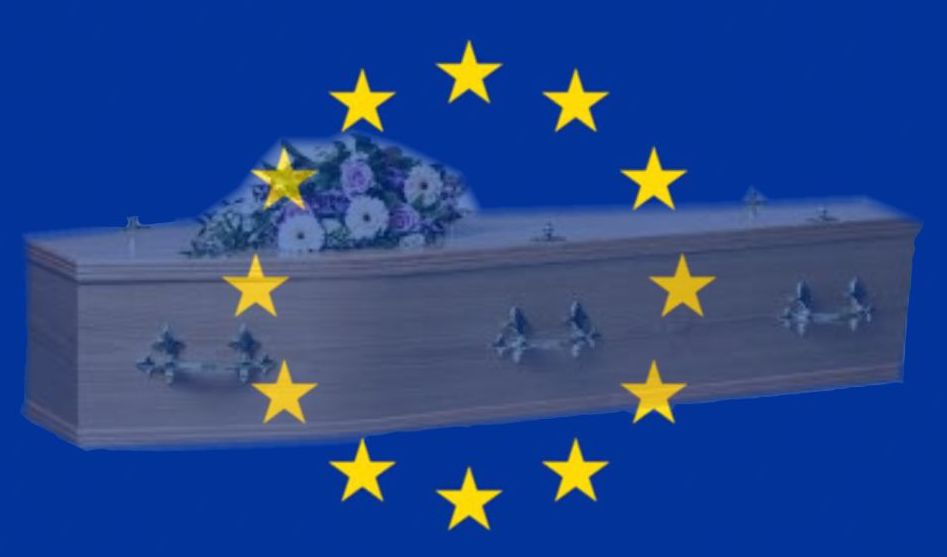
The EU could be on the verge of disaster.
A series of political elections will be held in 2017, with many to
be fought on lines of ‘for’ and ‘against’ membership of the euro. For
the first time since its inception in 1957, the European Union cannot
afford to take its future for granted.
Why?
Economic output in the region has been dire for almost 20 years.No one pretends the single currency hasn’t contributed to the malaise.
As a response to the continent’s sovereign debt crisis, the
European Commission set up the ‘S0’ Indicator – to analyse a country’s
economic data.
In February this year, a report from Deutsche Bank warned that,
according to the S0 indicator, SIX EU member states are now a financial
concern. Its conclusion is especially worrying:
“Even if impending fiscal crises are signalled correctly, there
might not be enough time left to counteract the critical developments.”
This is like having an earthquake warning system in place… but with no means to evacuate.
Make no mistake about it: this is an urgent matter – and your
money is at stake. As I will explain in this letter, unless evasive
action is taken now, British savers and investors will not avoid the
fallout of any European crisis.
Poor economic performance invariably manifests itself politically.
That makes this year a critical juncture for Europe’s future. And it will play out as the following elections take place:
France – 7th May: The far-right Front National party is the
second favourite to win the Presidential election, and is avowedly
anti-EU. Its leader Marine Le Pen plans to reintroduce the Franc. Even if they don’t win, they are still pulling France in an increasingly anti-EU direction.
Italy – by April 2018: General election called after pro-EU PM Matteo Renzi was comprehensively defeated on 4th December 2016 in a constitutional referendum. Italy’s three opposition parties are in favour of leaving the euro, which they believe is preventing the country’s economy from growing.
Germany – by October: Angela Merkel’s CDU party has been
losing seats to the anti-EU AFD. While unlikely at this point, a Merkel
defeat would be the biggest possible blow to the EU’s future. Germany is
the continent’s biggest economy.
The countries listed above are the three biggest economies in the
Eurozone. If one of them voted to leave the euro or the EU, it would
almost certainly precipitate the end of the European Union.
But the potential dangers do not end with them.
Hungary – by Spring 2018: The popular current Prime Minister
Viktor Orban has incurred the wrath of the EU by erecting wire borders
around the country – in defiance of the EU, which he openly disparages.
If just one of these countries left the EU, the financial strain
would be immense. The whole project would be called into question.
Britain has already left. Should another nation follow… it would be like
a theatre filling up with smoke – how long before it becomes a rush to
the exit?
Monday, 20 March 2017
Entire EU Banking sector approaching it's "LEHMAN MOMENT"
The perilous situation of Europe’s largest banks can no longer be ignored.

The entire banking system in Europe could be fast approaching a
‘Lehman moment’. And it threatens to trigger a contagious wave of
financial and social unrest.
Whilst Brexit dominates every newspaper and broadcast… the
unravelling of the banking system in the EU has gone largely unreported.
But if you have savings in a UK bank or money in the markets…
It demands your immediate attention.
This situation has run so far out of control that Amsterdam-based financial think tank Transnational Institute believe:
"This ticking time bomb will explode. We can see that currently many Italian and Spanish banks are in a difficult situation. De facto they are bankrupt. Deutsche Bank also has problems. A new collapse is likely in the banking sector, and it will be worse than the 2008 financial crisis.If this happens the European Central Bank and European governments will not be able to handle it".
You have time to prepare – but it is impossible to say how long.
We have prepared an urgent briefing to show you exactly why the Europan banking system has hit a point of criticality.
As you will see – British banks are vulnerable to a European banking collapse. Think about your money.
Nick O’Connor
Associate Publisher, Capital & Conflict
.
Saturday, 29 October 2016
FBIs cozy connections to the Clintons
The deputy FBI director one Andrew McCabe who investigated Mrs Clintons email server activities and found her not guilty of any wrong doing it turns out benefitted from a substantial donation made by Virginia Govenor Terry McAuliffe, a Democrat with ties to the Clintons, who gave nearly $500,000 to the state senate election campaign of McCabes, wife. She lost the election.
FBIs Deputy Director implicated in $500,000 Clinton election donation influencing his decisions
Meanwhile the current director of the same FBI James Comey was a director of HSBC bank during a period the same bank oversaw $81 million foreign payments into the Clinton foundation. HSBC was at the time implicated in laundering drug cartel money & was heavily involved in the LIBOR scandal. Sandy Berger was a Clinton aide who was caught removing and destroying secret records from the US National Archives. The documents were related to Clinton administration activities prior to the 9/11 attack. Comeys involvement in the case saw him as deputy attorney general hamstring the investigation by actively excluding Clinton administration officials who allegedly colluded with Berger during his illegal activities.
FBI director James Comey-& -ex Clinton foundation board also worked for HSBC
FBIs Deputy Director implicated in $500,000 Clinton election donation influencing his decisions
Meanwhile the current director of the same FBI James Comey was a director of HSBC bank during a period the same bank oversaw $81 million foreign payments into the Clinton foundation. HSBC was at the time implicated in laundering drug cartel money & was heavily involved in the LIBOR scandal. Sandy Berger was a Clinton aide who was caught removing and destroying secret records from the US National Archives. The documents were related to Clinton administration activities prior to the 9/11 attack. Comeys involvement in the case saw him as deputy attorney general hamstring the investigation by actively excluding Clinton administration officials who allegedly colluded with Berger during his illegal activities.
FBI director James Comey-& -ex Clinton foundation board also worked for HSBC
Thursday, 27 October 2016
Ex Lib Dem peer suspended after House of Lords anti Jewish meeting
Laura Hughes, political correspondent
27 OCTOBER 2016 • 4:46PM
A peer and former Lib Dem MP has been suspended from the party after hosting an event where the audience applauded the suggestion that Jewish people were responsible for the Holocaust.
Baroness Tonge, who sits as an independent in the Lords, hosted a meeting in Parliament where a speaker compared Israel to terror group the Islamic State of Iraq and the Levant.
Her suspension comes after a spokesman for the Israeli embassy described the event as "a shameful event" that "gave voice to racist tropes against Jews and Israelis alike".
House of Lords
The Palestinian Return Centre, which live streamed the event on its Facebook page, said the event inside Parliament was part of its Balfour apology campaign - which calls for the UK Government to "officially apologise for its past colonial crimes in Palestine".
One member of the audience was applauded after they claimed that “if anybody is antisemitic, it’s the Israelis themselves.”
She was photographed campaigning earlier this week with Sarah Olney, the Lib Dem's candidate in the Richmond Park by-election.
Screen shot of Lib Dem tweet
A Lib Dem spokesperson said: "The party has suspended the membership of Jenny Tonge. We take her comments very seriously and have acted accordingly.”
Cabinet minister David Lidington told MPs he was "genuinely horrified" by reports of the remarks.
Speaking in the Commons Mr Lidington said: "I read the newspaper reports of the event in question and I confess I was genuinely horrified by the speech that was reported there.
The peer has been suspended from the Lib Dem Party CREDIT: CHRIS RATCLIFFE/BLOOMBERG
"I don't want to treat every newspaper article as gospel but I think we should all be very concerned about what happened there. "And I hope that since this appears to be an event organised by a leading member of the Liberal Democrat party, that the leader of the party does launch an immediate and thorough investigation so we can get to the truth and any appropriate disciplinary action can be taken."
In the Lords Lady Tonge lists her party as "independent Liberal Democrat".
In 2010 she was sacked as the party's health spokeswoman in the Lords after calling for an inquiry into allegations that Israeli soldiers supporting the relief effort in Haiti had been involved with organ-trafficking.
Lady Tonge was a Lib Dem MP between 1997 and 2005, when she entered the Lords. She has regularly run into controversy for her critical stance towards Israel. In 2004, she was sacked as a Lib Dem spokeswoman on children's issues after suggesting she could consider becoming a suicide bomber.
27 OCTOBER 2016 • 4:46PM
A peer and former Lib Dem MP has been suspended from the party after hosting an event where the audience applauded the suggestion that Jewish people were responsible for the Holocaust.
Baroness Tonge, who sits as an independent in the Lords, hosted a meeting in Parliament where a speaker compared Israel to terror group the Islamic State of Iraq and the Levant.
Her suspension comes after a spokesman for the Israeli embassy described the event as "a shameful event" that "gave voice to racist tropes against Jews and Israelis alike".
House of Lords
The Palestinian Return Centre, which live streamed the event on its Facebook page, said the event inside Parliament was part of its Balfour apology campaign - which calls for the UK Government to "officially apologise for its past colonial crimes in Palestine".
One member of the audience was applauded after they claimed that “if anybody is antisemitic, it’s the Israelis themselves.”
She was photographed campaigning earlier this week with Sarah Olney, the Lib Dem's candidate in the Richmond Park by-election.
Screen shot of Lib Dem tweet
A Lib Dem spokesperson said: "The party has suspended the membership of Jenny Tonge. We take her comments very seriously and have acted accordingly.”
Cabinet minister David Lidington told MPs he was "genuinely horrified" by reports of the remarks.
Speaking in the Commons Mr Lidington said: "I read the newspaper reports of the event in question and I confess I was genuinely horrified by the speech that was reported there.
The peer has been suspended from the Lib Dem Party CREDIT: CHRIS RATCLIFFE/BLOOMBERG
"I don't want to treat every newspaper article as gospel but I think we should all be very concerned about what happened there. "And I hope that since this appears to be an event organised by a leading member of the Liberal Democrat party, that the leader of the party does launch an immediate and thorough investigation so we can get to the truth and any appropriate disciplinary action can be taken."
In the Lords Lady Tonge lists her party as "independent Liberal Democrat".
In 2010 she was sacked as the party's health spokeswoman in the Lords after calling for an inquiry into allegations that Israeli soldiers supporting the relief effort in Haiti had been involved with organ-trafficking.
Lady Tonge was a Lib Dem MP between 1997 and 2005, when she entered the Lords. She has regularly run into controversy for her critical stance towards Israel. In 2004, she was sacked as a Lib Dem spokeswoman on children's issues after suggesting she could consider becoming a suicide bomber.
Wednesday, 5 October 2016
Poland will not support Tusk for second term as European Council President, conservative leader says
Jaroslaw Kaczynski, the leader of Poland’s ruling Law and Justice party (PiS), told the Polska newspaper that the Polish government will not support Donald Tusk, a former Polish prime minister, for a second term as President of the European Council.
Kaczynski argued, “Tusk is a major problem. There are investigations going on in Poland in the parliament and in the prosecutor’s office that may lead to pressing some charges against him.
Should such a person be the head of the European Council? I have serious doubts.” He added that Tusk’s “further stay in Brussels is highly risky, mainly for the EU.”
Source: Reuters
Kaczynski argued, “Tusk is a major problem. There are investigations going on in Poland in the parliament and in the prosecutor’s office that may lead to pressing some charges against him.
Should such a person be the head of the European Council? I have serious doubts.” He added that Tusk’s “further stay in Brussels is highly risky, mainly for the EU.”
Source: Reuters
Subscribe to:
Posts (Atom)